Featured

News Article # 1

Consumer spending on track for worst year in decade, says National Bank

Date: Feb 05, 2019 ( article written by Rajeshni Naidu-Ghelani)

Link: https://www.cbc.ca/news/business/consumer-spending-consumption-canada-1.5006343

Summary: Economics are expecting that consumer spending will fall to the lowest since 2009 global financial crisis. Consumption growth is the using up of goods and services by consumer purchasing or in the production of other goods. It will hit 1.3 per cent in 2019, which would be the lowest since 2009 when it fell to 0.2 per cent. According to National Bank, the main reason of this is housing prices, people have a pressure from higher interest rates that will result in less consumer spending. According to retail sales data for November from Statistics Canada, last month consumption growth fell more than expected, by 0.9 per cent. Higher interest rates are also hurting the ability of households to spend. The Bank of Canada has raised rates five times since mid-2017. Overall, National Bank predicts real consumption grew by 2.2 per cent last year, but it will slow to 1.3 per cent this year, and slow further to 1.2 per cent in 2020.

Stakeholders: & how different people/organizations can be effected:  

Economy: (-) will decrease because consumption has a huge impact on economy. If, people will spend less then other people’s income will fall too.

Businesses: (-) Businesses can open up and offer all kinds of great products, but if we don’t purchase or consume their products, they won’t stay in business for very long!

Government: (-) The government will not be able to collect tax money and therefore, they will not be able to spend more money on public goods and services.

Inflation: (-) Prices of goods and services will decrease because of less consumer spending.

Unemployment rates and salaries: (-) If, businesses will shutdown, they will not be able to give salaries and they will fire their employees.

Borrowing: (-) will decrease because people will not be able to spend more on goods and services and therefore, borrowing will decrease.

Personal Opinion: As consumers, we buy so many goods and services, but if we consume less goods and services, then someone else’s income will drop which will effect our GDP growth, inflation rates, unemployment rates, borrowing, interest rates, so on and so forth. To conclude this sentences, it means that it will effect the whole business cycle. All the things are connected to each other. If GDP falls because of consumer spending, then there will be a recession. And if this will happen Canada’s economy will be at recession stage.

Questions: When I was writing that how different organizations will be effected, I couldn’t find anything/anyone who will be benefitted if consumer spending will fall.

Do you think if anyone can have a benefit from this?

Response to Econ Article: Bank of Canada Abandons Rate- Hike Bias Amid Economic Slowdown

Analysis: Canada’s economy is struggling with a slowdown and because of that Bank of Canada abandoned its bias towards raising interest rates. Policy makers in Ottawa left their standard overnight rate unchanged at 1.75 %. Markets were expecting the change in stance but there is no chance of prices going up this year while pacing some odds on a rate cut. The Canadian currency dropped 0.5 percent to C$1.3488 per U.S. dollar, the lowest since Jan. 3. One dollar buys 74 U.S. cents. Yet even with the more dovish tilt and growth revisions, officials seem to be trying not to settle market bets on lower borrowing costs. The Bank of Canada stuck to its expectations of a rebound from the current soft patch, and predicted the extra slack created by the slowdown will eventually be absorbed. Poloz believe that interest rates are more likely to go up than down. Consumer-price Inflation is expected to remain close to the Bank of Canada’s 2 percent target throughout the projection period.

Stakeholders:

Importers of goods: Because the Canadian currency is weak, the importers of goods will be benefitted. They can sell their products more expensive to Canada.

Exporters of Canadian Goods: They will be affected negatively because the price of their product is cheap because the Canadian currency is weak.

Personal Opinion: I think the lower interest rates would contribute in GDP growth positively because people can borrow more from the banks and as result, spending will increase. Foreign investment will go down because when the interest rates are low, the currency goes down. Lower interest rates tend to be unattractive for foreign investment and decrease the currency’s relative value. Unemployment rates will go down. Extra spending spurred by lower interest rates helps companies hire more employees to handle the growth in business. When businesses hire more workers and increase production, people have more money in their pockets and are more likely to spend it. This takes a little time to show up in the economy, but with more people spending money, unemployment rates tend to drop even more. The demand for Canadian dollar goes down because of the lower interest rates. The Canadian currency will become weak.

News Article #11: Bell and Telus beef up data plans after Rogers sparks ‘unlimited’ price war

Posted: Jun 13, 2019 (article written by CBC news)

Link: https://www.cbc.ca/news/business/bell-matches-rogers-cellphone-data-plans-1.5173641

Summary: Bell Canada has followed Rogers by matching an “unlimited” cellphone data plan with no overage fees for downloading more than 10 gigabytes of data each month. But like the Rogers plan announced yesterday, customers will experience slower speeds once those 10 gigabytes have been used. Both companies are offering the service starting at $75 per month. The announcement on Bell’s website said that beyond 10 gigabytes, “speeds will be reduced for light web browsing, email and texting.”  Telus, meanwhile, also came out on Thursday with a beefed up data plan that would allow customers up to 15 GB per month for $75. Unlike Rogers’ plan which the company says is permanent, and similar to Bell’s which is a promotional offer, the Telus offering is only for a limited time, available to anyone who signs up by July 2. While offering a higher data limit, the Telus offer is not “unlimited” in that any customer who goes over the 15 GB limit in a month would be charged the usual pay-per-use overage rate of $10 per 100 MB. Nonetheless, the beefed up data plans represent a shift in Canada’s cellphone service landscape, where companies have been slower to adopt unlimited plans than their counterparts in the United States. However, unlimited data plans have been available from regional competitors, such as SaskTel in Saskatchewan and Freedom Mobile, which operates wireless networks in Ontario, Alberta and British Columbia.

Stakeholders: How different people and organizations can be affected:

Bell, Rogers and Telus: These companies will be affected because they are offering “unlimited” cellphone data. It’s not been clear yet that which company will be able to make more profit.

Consumers: They will be affected negatively and positively. They are getting “unlimited” cellphone data which affects the consumers in a positive way but after 19 gigabytes they will experience slower speed.

Competitors: Other companies will be affected negatively because of these plans. As a result, they will loose their customers.

Non-users: People who don’t have cellphone data plans will not be affected.

Users of Social Media: People who use social media will be affected because of these changes.

Personal Response: I think people will not switch their data plans and they will stay with the same company because the data plans of Bell, Telus and Rogers have kind of similar things. But the companies will try to attract more customers by giving them fast speed.

Questions: Do you think people will switch their cellphone data plans?

How can these companies attract more customers?

Great Depression

  1. What factors contributed to great depression?
    – Unequal distribution of wealth
    – Over-speculation in the stock market
    – Federal regulations on businesses
    – High tariffs and war debts helped spread the depression world wide
    – Stock market crash of 1929
  2. What difficult decisions did families have to make?
    – During the Great Depression families had to survive on little money and focus on the necessities of life. Wages went from $25 a week in a job for manufacturing in 1929 to $16 a week in 1933. This made it very difficult for families to make ends meet. Many families started their own gardens to produce food.  Unemployment effected men the most, especially those between the ages of 35-55. This was a time in their lives when family responsibilities were the greatest. In the poorest of families, children would take turns eating. Children had no toys to play with, as a family couldn’t afford luxury items. Some children even had no food and clothing.
  3. How does society get out of recession/ deep depression?
    – Contain Inflation
    – Encourage Imports of High-Priced Commodities
    – Discourage Borrowing if Inflation is Ruling High
    – Encourage savings
    – Cut Taxes
    – Reduce Government Expenditure and Focus on Infrastructure Development
    – Encourage Exports
    – Reduce Interest Rates
    – Encourage Foreign Direct Investments
    – People Need to Wok More
    – Pay your Debt First
    – Pay Taxes Promptly
    – Buy Assets
    – Always have a job

Bank and Money Supply

  1. What role did you play in the scenario? What experiences/challenges did you have?
    – In the first activity, I played a role of a banker and in the second one I played a role of a medium-risk borrower. As a banker, it was hard to have more people depositing in our bank. And as a medium-risk borrower, it was hard to get the money from the banks compared to low-risk borrowers.
  2. In this activity the incentive for banks to make loans was candy/points. What incentives do banks have for making loans in the real world? What incentives do people have for keeping their money in the bank?
    – In the real world, banks receive more interest rates from borrowers. And when people invest their money in the banks, they get more money in return and also their money is always safe except when bank has nothing left to give away.
  3. We started with a money supply of only $40,000 and we finished with a whole lot more that than….where did the extra money come from?
    – The new money came from people who were investing in different banks. Every time people took money from the banks and deposited in different banks which helped in increasing the total deposit at the end of each round.
  4. What would the borrowers do with all the money they borrowed? Would their activity be helpful or harmful for an economy? How can you tell?
    – Borrowers spend their money on different goods and services for eg: they buy cars. It can be both harmful and helpful because if borrowers are spending money and returning it on time to the bank then it’s helpful which contributes in country’s economic growth. If they are not returning the money, then banks will not be able to pay other people who invested in their banks.
  5. In our simulation, all of the loans were “good” loans because all the borrowers paid them back. What would happen in an economy where people stopped paying back their loans? What would banks be forced to do?
    – If people stopped paying back their loans then there will be an economic depression in the country. Bank will not get their money back from the borrowers and as a result bank will not be able to pay you back because the money you have in your bank account is a form of debt owed to you by the bank.
  6. Banks held 20% of deposits on reserve in this simulation. What would happen to the simulation if it were changed to 30%? What if it were changed to only 10%?
    – If it was changed to 30%, then the money that people have deposited in the banks could’ve been more secure because bank can not give that 30% of deposits on reserve to anyone. If any depositor needed money, there were more chances of getting most of their money from their bank accounts. If it was changed to 10%, there could’ve been less chances for the depositors to get their money back.
  7. Most economic textbooks say that banks “create” money. After our simulation would you agree with this statement? Why or why not?
    – I am somewhat agree with this statement because it’s the investors who create money for other people to buy. If people are not depositing their money into the banks, then banks will not be able to lend it to someone. For eg: when we were playing this activity, people were depositing into banks and then banks were lending their money to someone else.

News Article# 10: Alberta makes it official: Bill passed and proclaimed to kill carbon tax

Posted on June 5, 2019 (article written by the Canadian Press)

Link: https://www.cbc.ca/news/canada/edmonton/alberta-carbon-tax-repealed-1.5162899

Summary: Alberta’s consumer carbon tax is now officially gone. Legislature members voted to pass the bill that repeals the tax, and it was signed into law by Lt.-Gov. Lois Mitchell. The tax first came into effect on Jan. 1, 2017. The province stopped charging it and the federal government announced it will soon replace the fee with its own carbon levy. The provincial carbon tax, implemented by the former NDP government, added a surcharge to gasoline at the pumps and on fossil-fuelled home heating. The Carbon Tax Repeal Act was the first piece of legislation introduced by Premier Jason Kenney and his newly elected United Conservative government. Kenney won the April election on a promise to kill the tax, saying it hasn’t helped reduce greenhouse gas emissions and took money out of the pockets of working families. Kenney’s government will continue with a tax on large industrial greenhouse gas emitters, and has promised to challenge the constitutionality of the federal carbon tax in court if Ottawa imposes it. Ending the tax opens the door to Ottawa imposing its tax, as it has done with four other provinces that wouldn’t bring in their own carbon pricing: Ontario, New Brunswick, Manitoba and Saskatchewan.

Stakeholders and how different organizations can be affected:

Government: The Government will receive less taxes because of the Tax Repeal Act.

Consumers in Alberta: They will be benefitted because now they will be paying less and also they will spend more which will contribute in country’s economic growth.

Environment: There will be no affect on the environment problems and they will remain the same because before the Tax Repeal Act the greenhouse gas emission didn’t reduce.

Premier Jason Kenney: He will be benefitted because he fulfilled his promise and gain people’s confidence.

Consumers in B.C: They will be dissatisfied because there’s still carbon tax in B.C. and probably they would also like this carbon tax to be removed.

Personal Opinion: I think the Government should remove the carbon tax in Canada because if it’s not helping in reducing the greenhouse gas emissions then there’s no point of having it. It’s just a burden on consumers which leads them to spend less on other goods and services.

Question: Do you think that carbon tax should be removed?

What other things the government can do to reduce environmental problems?

Huawei

  1. What is Huawei?
    Huawei Technologies Co. Ltd. is a multinational networking and telecommunications equipment company based out of China. Huawei is the largest telecommunications equipment manufacturer in the world.
  2. What is 5G?
    – 5G is the term used to describe the next-generation of mobile networks beyond LTE mobile networks. 5G technology is a huge upgrade over 4G technology. While 4G technology can transfer information within 100MB per second, the 5G technology can transfer data in 20GB per second.
  3. Why is 5G important to the USA?
    – The US president Donald Trump has recently stated that US must win the 5G technology race and become the leading country of the technology. Trump also revealed the White House plan to ban Huawei. Huawei, one of the leading 5G technology companies in the world is facing accusations from the US government and NATO allies. There are growing concerns that the Chinese government will use Huawei’s 5G technology to spy on other countries and use the company’s technology as part of its cyber warfare operation.

News Article# 9: Minimum wage in B.C. increases to $13.85 an hour today

Posted: Jun 01, 2019 (article written by Chad Pawson)

Link: https://www.cbc.ca/news/canada/british-columbia/minimum-wage-british-columbia-13-85-june-1-2019-1.5158429

Summary: The minimum wage in B.C. is going up to $13.85 from $12.65. According to anti-poverty campaigners, it’s still woefully below what’s needed to afford a good life in the province. The living wage, which is what a working couple with two children needs to earn to pay for things like housing, child care, and transportation is calculated at $19.50 per hour for 2019 for Metro Vancouver by the Living Wage for Families Campaign. Halena Seiferling, who speaks for the campaign in B.C., says the gap amounts to tens of thousands of dollars in lost revenue for families who need it. “There’s still a significant gap there,” she said of the difference between the minimum wage and the living wage. Saturday’s increase for the province’s lowest paid workers is part of the provincial government’s plan to raise the current wage to just over $15 an hour by 2021. The province says the plan will help to make life more affordable for people, while also allowing businesses to plan around how to afford the wage. Next June, the minimum wage will rise to $14.60 an hour before going up to $15.20 on June 1, 2021.

Stakeholders and how different organizations can be affected:

Workers: People who are working on minimum wage will be benefitted because now they are earning $1.20 more per hour.

Businesses: They will be facing a hard time because now they will be paying more to their workers.

Productivity: It will increase because now workers will be more pleased and as a result they will work more efficiently.

Unemployment: It will go up. Some workers may loose their jobs and also it will be hard for youth to get jobs because business can’t afford to hire new workers.

Spending: Workers are getting more money and as result they will be spending more on goods.

Personal Opinion: I think it will affect the businesses for a short period of time. It will also contribute to the GDP growth of the province because people will start spending more. I think the government should try to make it more equivalent to the living wage because that will reduce the poverty rates in the province.

Question: 1) Do you think that the government should raise the minimum wage and make it equivalent to the living wage?

2) If this happens, do you think it is fair for the businesses?

News Article# 8: Reports that Huawei cancelling U.S. meetings, sending home American employees

Posted on May 31, 2019 (By the Associated Press)

Link: https://www.cbc.ca/news/business/reports-that-huawei-cancelling-u-s-meetings-sending-home-american-employees-1.5157620

Summary: After U.S. restricts U.S. firms from dealing with Huawei, China to draft own list of ‘unreliable entities’. The Financial Times reported that tech giant Huawei has ordered its employees to cancel technical meetings with American contacts and has sent home numerous U.S. employees working at its Chinese headquarters. The moves come amid growing U.S.-China tensions over trade and technology in which Huawei has been a main target. The FT said a workshop underway at Huawei at the time was “hastily disbanded, and American delegates were asked to remove their laptops, isolate their networks and leave the Huawei premises.” It quoted Dang as saying that Huawei is also limiting interactions between its employees and American citizens. Huawei declined to comment on the FT report. China’s commerce ministry announced that it will establish its own list of foreign enterprises, organizations and individuals it deems to be “unreliable entities” — a possible response to the U.S. blacklist. Entities are “unreliable” if they “fail to comply with market rules, break from the spirit of contracts and block or stop supplying Chinese enterprise for non-commercial reasons, seriously damaging the legitimate rights and interests of Chinese enterprises,” ministry spokesman Gao Feng said at a news briefing. The purpose of the list is to safeguard China’s national security.

Video: https://www.youtube.com/watch?v=rCconxImo5o

Stakeholders and how different organizations can be affected:

US economic growth: Economic growth of US will decrease because China is sending American citizens who are working at Chinese headquarters. Also, the relations between America and China are getting worse which has a huge impact on the economic growth.

China’s economic growth: It will go down as well because America restricts the US firms from dealing with Huawei which is a huge tech company.

Huawei: The profit margins of the company will go down.

World’s economy: China and US are world’s two biggest economies which will affect other countries economies as well.

Workers in Huawei: People who are working in Huawei will be affected as well. Some workers will lose their jobs.

American workers: American people who are working at Chinese Headquarters lost their jobs because China is sending them back to America.

Other tech companies: They will be benefitted because of the restrictions on Huawei in America.

Personal Opinion: I think US should not be doing this with China because China is a huge country not only because of their population but also because of their economy. If US continues doing this to China, US economy will be affected really badly. If this happens common people will be affected and unemployment rates will go up.

Questions: 1)Do you think that American Government should keep the restrictions on Huawei?

2) Do you think China is fair with American employees who are working at Chinese Headquarters?

News Article# 7: U.S. raising tariff on Chinese imports to 25% from 10%

Link: https://www.cbc.ca/news/business/u-s-raises-tariff-on-chinese-imports-to-25-per-cent-1.5127405

Posted: May 08, 2019 (article written by Thomson Reuters)

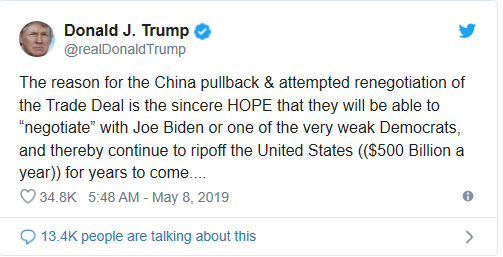
Summary: The United States will raise tariffs to 25 per cent from 10 per cent on $200 billion worth of Chinese imports. The change comes as Chinese Vice Premier Liu He goes to Washington for trade talks, setting up a last-ditch bid for progress toward a deal that would avoid a sharp increase in tariffs on Chinese goods. U.S. officials have accused China of breaking a contract in the past week on substantial commitments made during months of negotiations to end their trade war, prompting Trump to set a new deadline to raise tariffs on $200 billion worth of Chinese goods to 25 per cent from 10 per cent. U.S. President Donald Trump said on Wednesday he would be happy to keep tariffs on Chinese imports in place, adding that China is mistaken if it hopes to negotiate trade later with a Democratic presidential administration.

“Guess what, that’s not going to happen! China has just informed us that they (Vice-Premier) are now coming to the U.S. to make a deal. We’ll see, but I am very happy with over $100 Billion a year in Tariffs filling U.S. coffers,” he added. China’s exports fell unexpectedly in April, adding to pressure on Beijing ahead of the negotiations with Washington over Chinese technology ambitions. Earlier this week Trump sent global financial markets plunging with a surprise threat of more penalties on Chinese imports. April exports sank 2.7 per cent from a year ago to $193.5 billion US, a reverse from March’s 14.2 per cent growth, customs data showed. Imports rose four per cent to $179.6 billion, rebounding from the previous month’s 7.6 per cent decline. Imports of American goods fell 26 per cent from a year earlier to $10.3 billion. Exports to the United States, China’s biggest foreign market, were down 13 per cent at $31.4 billion.

Stakeholders and how different organizations can be affected:

USA Economic growth: It will go up because now they will be able to receive more tariffs on China’s imports. As Donald Trump said that “I am very happy with over $100 Billion a year in Tariffs filling U.S. coffers” means they will receive about $100 Billion a year only in tariffs.

China’s Economic growth: It will go down because of the increase in tariffs and now they will be paying more tariffs on their imports.

Imports of China: As a result, imports rose four per cent to $179.6 billion, rebounding from the previous month’s 7.6 per cent decline.

Imports of America: Imports of American goods fell 26 per cent from a year earlier to $10.3 billion.

Exports of China: China’s exports fell unexpectedly in April. They are down 13% at $31.4 billion.

Unemployment: Probably, it will go up in China because of the fall in economic growth.

Goods and services: China may increase the prices of goods and services (that they are importing) because of the tariffs.

Consumer Spending: It will fall because if they rise the prices, lower and middle class people will not be able to spend more on consumer goods.

GDP growth: Consumer spending and unemployment rates might affect GDP growth and as a result, it will go down.

Personal Opinion: I think this will affect other countries too because USA and China are world’s biggest economies and it will affect their trade market. China is highly populous and the increase in tariffs might affect their employment rates, prices of goods and services, consumer spending and their economic growth. On the other hand, America’s economic growth will go up because now they will be able to receive more tariffs on Chinese imports.

Question: If you are a Chinese government, would you continue your trade (imports and exports) with America? Why or why not?

News Article# 6: Pipeline constraints cost Canadian oil producers $20 billion in lost revenue last year: report

Posted: Apr 30, 2019 (written by John Paul Tasker)

Link: https://www.cbc.ca/news/politics/pipeline-constraints-cost-20-billion-canadian-oil-report-1.5116790

Summary: Canadian oil producers could have collected $20 billion more in revenue last year if they’d been able to sell their product at prices closer to the going world rate, according to a new study from the Fraser Institute. The conservative-leaning think tank said that, Canadian heavy crude oil traded at an average discount of $26.50 U.S. That price discount is far larger than it was in the preceding five years, when producers were seeing a gap of just $11.90 U.S. a barrel. Because oil is one of the country’s most valuable exports, the estimated revenue loss works out to approximately one per cent of Canada’s national gross domestic product (GDP), the institute said. With 99 per cent of Canadian crude exports destined for refineries in the U.S., producers are forced to either store product and wait out price dips or offload product at discounted rates. Other companies have turned to crude-by-rail transport — a far more costly and potentially more dangerous option — to send product to the Gulf Coast, where prices are higher for Canadian heavy crude than they are at Midwest U.S. refineries. A mandatory production cut instituted by then-Alberta Premier Rachel Notley, and a promise to buy more rail cars to move product, helped stabilize the Canada-U.S. price gap last year, but the institute said building more pipelines is the most practical long-term solution for Alberta’s oil patch.

Stakeholders and how different organizations can be affected:

Canadian oil producers: They lost a revenue of $20 billion because they traded at an average discount of $26.50 to U.S.A.

Canada’s economic growth: It will affect Canada’s economic growth because it is one of the country’s most valuable exports.

GDP growth rate: The estimated revenue loss impacted GDP by one percent.

Other countries: They will be effected neutrally because neither they will make money nor they will loss it.

Environment: It will be effected because of the building of more pipelines. As a result, people’s health will be affected too.

Personal Opinion: I think this will not affect me as a customer because the prices of crude oil in country will remain same. And this may affect employment rates because they are building more pipelines which may add on a little bit to country’s economic growth.

Question: Do you think this will effect you in any way? Why or why not?